March 21, 2026

Few terms have been more overused in board rooms and press releases overthe past decade than 'machine learning.' Yet beneath the hype lies a genuinely powerful set of techniques that are quietly solving real, costly business problems every day. Machine learning (ML) is a subset of artificial intelligence in which algorithms are trained to learn from data rather than being explicitly programmed with rules. The distinction matters: traditional software does what it is told, while machine learning software figures out whatto do based on examples and feedback.
In practice, machine learning algorithms fall into a few key categories that serve different business purposes. Supervised learning , the most common type , trains modelson labeled data to make predictions, such as classifying loan applications ashigh or low risk. Unsupervised learning finds hidden patterns in unlabeled data, ideal for customer segmentation or anomaly detection in financial transactions. Reinforcement learning, increasingly used in supply chain andpricing optimization, trains systems to make sequences of decisions byrewarding desirable outcomes. Each approach solves a different class ofbusiness problem.
Consider the impactof ML in customer service operations. Natural language processing (NLP)algorithms , a specialized branch of machine learning , power the intelligent chatbots and virtual assistants that now handle millions of customer interactions per day across industries. Unlike early rule-based bots that frustrated users with rigid scripts, modern NLP-driven systems understand intent, context, and nuance. Companies deploying these systems have reported first-contact resolution rates improving by 30 to 40 percent while simultaneously reducing support staffing costs.
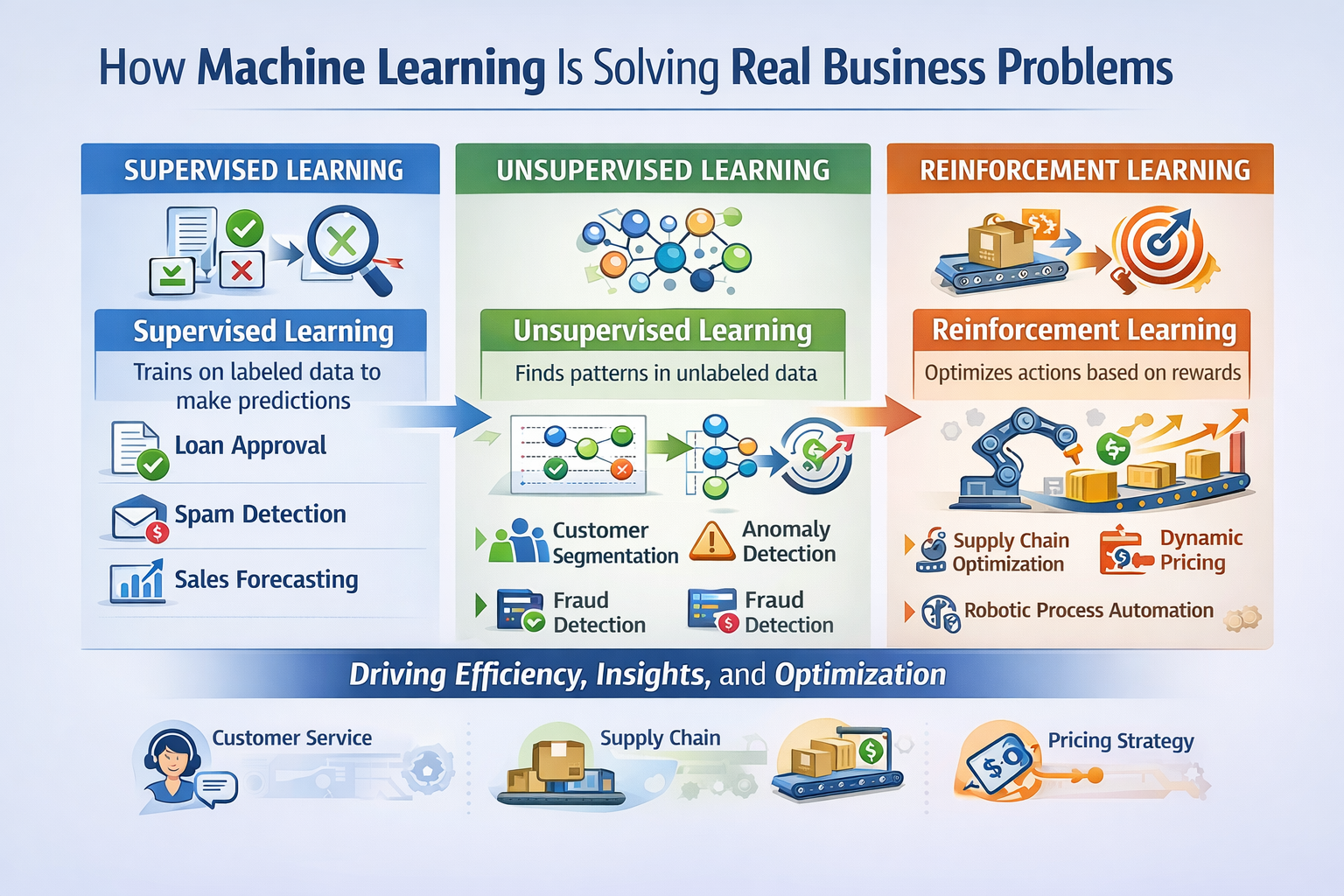
In supply chainmanagement, ML algorithms are being used to forecast demand with unprecedented accuracy, automatically adjusting inventory levels and logistics routes inresponse to real-time signals like weather, geopolitical events, and consumer behavior shifts. During global supply chain disruptions in recent years, companies with ML-powered supply chain tools were able to adapt significantly faster than those relying on traditional planning systems, avoiding costly stockouts and overstocking situations that hurt margins.
The message for business leaders is straightforward: machine learning is not a monolithic technology but a versatile toolkit with specific algorithms suited to specific problems. The most successful organizations approach ML not by asking 'how dowe use AI?' but by starting with a concrete business problem, excess customer churn, high fraud rates, inefficient scheduling , and then identifying which MLapproach can address it. Grounding AI adoption in business outcomes, rather than technological enthusiasm, is what separates organizations that see real ROI from those that don't.