July 27, 2026

Modern organizations generate enormous amounts of data every day. Customer transactions, financial systems, operational applications, employee activity, websites, IoT devices, cloud platforms, and third party applications all contribute information that can potentially improve business decisions. The challenge is that this information is often distributed across different systems, teams, and technologies, making it difficult to create a consistent view of the business. Microsoft Fabric addresses this challenge by bringing data integration, engineering, analytics, data science, real time intelligence, business intelligence, and AI capabilities into a unified platform. Microsoft describes Fabric as an end to end analytics platform in which different workloads operate within the same environment and can share data and artifacts without unnecessary duplication.
For business leaders, the important question is therefore not simply what Microsoft Fabric can do. The more important question is how Fabric can help an organization move from fragmented information to reliable insights and eventually to faster, more intelligent business action. Fabric provides the infrastructure and workloads required to connect data, prepare it, store it, analyze it, visualize it, and increasingly provide business context for AI and agents. OneLake provides the shared data foundation, while Fabric workloads provide specialized capabilities for different stages of the data journey. Power BI turns trusted data into business intelligence, while newer capabilities such as Fabric IQ introduce a stronger semantic and contextual layer for AI driven decision making.
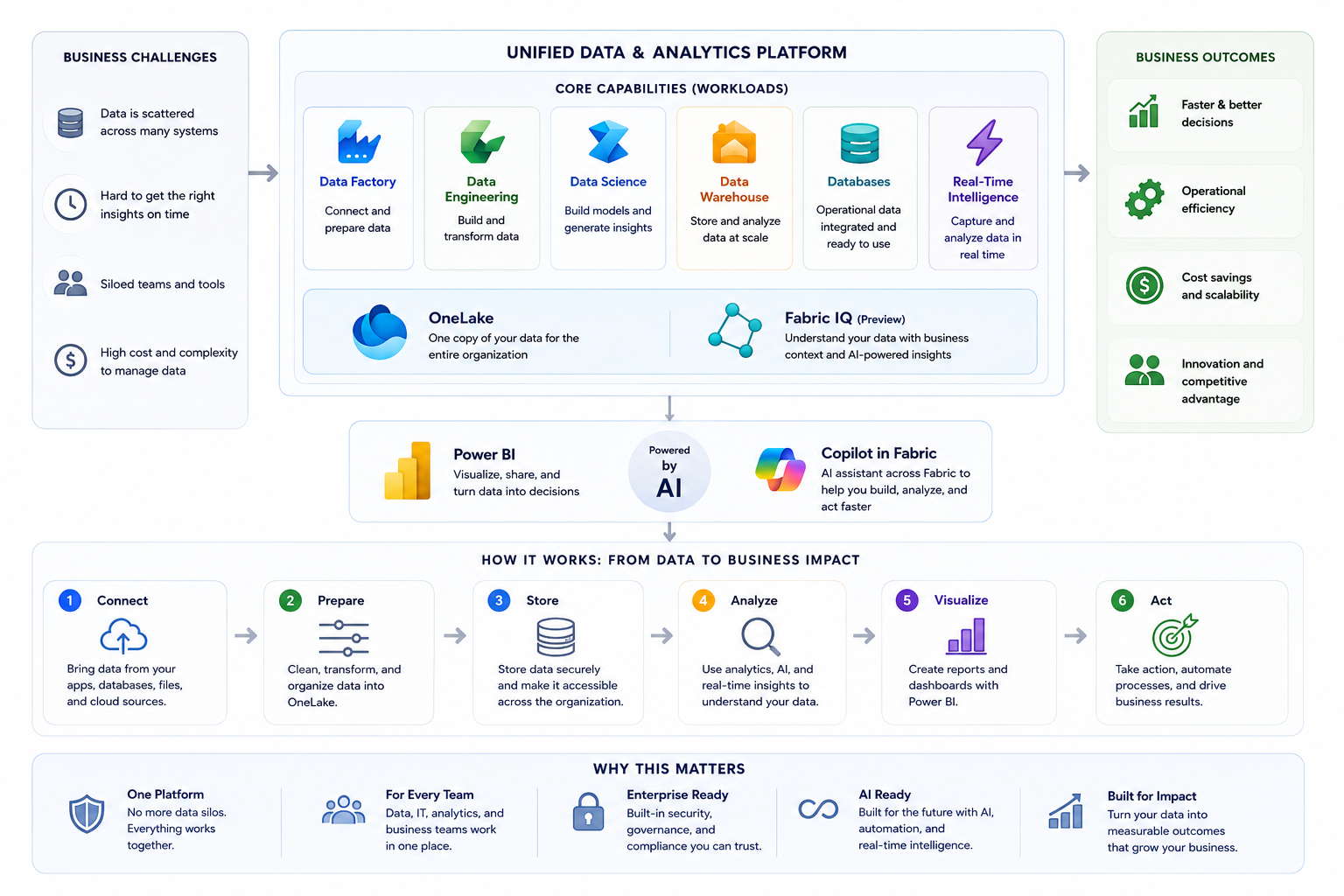
Microsoft Fabric is a unified data and analytics platform designed to support the complete data lifecycle within one environment. Instead of requiring organizations to assemble separate services for data integration, data engineering, data warehousing, data science, real time analytics, and business intelligence, Fabric brings these capabilities together as interconnected workloads. Each workload addresses a specific business or technical requirement while operating on the same underlying platform. This allows organizations to build solutions that move from raw data to analysis and business action without creating disconnected data environments for every use case. Microsoft also describes Fabric as supporting a data mesh architecture, allowing different teams to work with data while maintaining a common platform and governance model.
A simple way to understand Fabric is to think about it as a business data journey. Data enters from operational systems, applications, files, cloud services, databases, and streaming sources. Fabric then provides tools to connect, ingest, transform, organize, store, analyze, and visualize that information. Machine learning and AI capabilities can be applied when organizations need predictive or intelligent analysis. The resulting information can then support reports, dashboards, business decisions, automated processes, and increasingly AI agents that interact with business data. This creates a progression from data to insight to intelligence to action.
The input to Microsoft Fabric can come from many different sources because modern businesses rarely operate from a single system. Organizations may have customer information in CRM platforms, financial data in ERP systems, transactions in operational databases, marketing data in digital platforms, documents in cloud storage, and event data coming from applications or connected devices. Fabric's Data Factory capabilities are designed to connect to these different sources and bring data into analytical workflows. Microsoft describes Data Factory in Fabric as a data integration solution designed to turn scattered data into useful insights through ingestion, transformation, and orchestration.
The sources can include structured data such as SQL databases and business applications, semi structured information such as JSON and XML, files such as CSV and Excel, and streaming or event based information. The exact architecture depends on the organization's systems, data volumes, security requirements, and business objectives. This flexibility is important because Fabric does not require an organization to start by replacing every existing system. Instead, Fabric can become an analytical and intelligence layer that connects existing data environments and makes their information more useful.
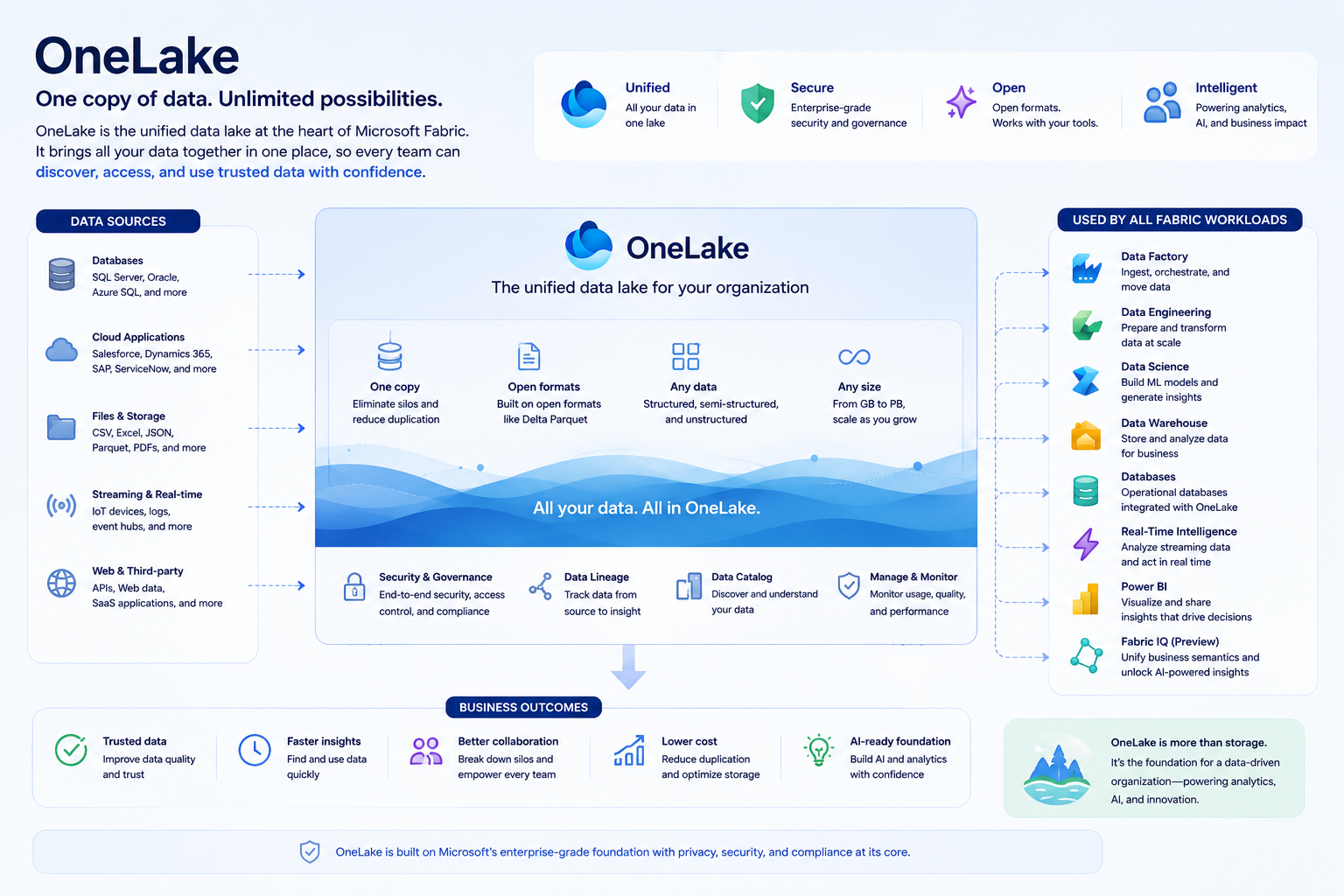
OneLake is one of the most important concepts for understanding Microsoft Fabric. Microsoft describes OneLake as a unified data lake for an entire organization and the single place for analytics data within a Fabric tenant. Every Fabric tenant includes OneLake, which acts as a central repository and foundation for analytics and AI workloads.
From a business perspective, OneLake helps address a common problem: data fragmentation. Without a unified foundation, organizations can end up maintaining multiple copies of the same information across different systems and analytics environments. Those copies can become inconsistent, difficult to govern, and expensive to maintain. OneLake is designed to reduce this fragmentation by providing a common data foundation that Fabric workloads can access and use. The result is a more consistent environment in which teams can work from shared data rather than repeatedly moving and duplicating information between disconnected platforms.
Microsoft Fabric is composed of multiple workloads, each designed for a different part of the data and analytics lifecycle. These workloads should not be viewed as isolated products because they operate within the same Fabric environment and can share data and artifacts. The current Fabric platform includes Data Factory, Data Engineering, Data Science, Data Warehouse, Databases, Real Time Intelligence, Power BI, and Fabric IQ as a preview workload.
Data Factory addresses the first major challenge in the data journey: getting information from different sources into the right analytical environment. It provides capabilities for data ingestion, transformation, orchestration, and integration. Organizations can use pipelines and other integration capabilities to move and prepare data for downstream workloads.
For a business leader, the value is straightforward. Data Factory helps create a repeatable process for getting information from different business systems into a usable analytical environment. Instead of analysts manually collecting data from multiple sources, organizations can establish automated data flows that continuously prepare information for analysis. Microsoft specifically positions Fabric Data Factory around the challenge of turning scattered data into useful insights.
Once data has been collected, it often needs to be cleaned, transformed, structured, and prepared. Fabric Data Engineering provides capabilities such as Lakehouse, Apache Spark, notebooks, and pipelines for processing large volumes of data. These capabilities allow data teams to build systems that collect, store, process, and analyze organizational data.
The business impact comes from improving the quality and accessibility of data before it reaches analysts and decision makers. Poorly structured data can create inaccurate reports, duplicated metrics, and unreliable analysis. Data engineering establishes the foundation required for more trustworthy analytics, machine learning, and AI.
Fabric Data Warehouse provides a SQL based environment for organizations that require structured analytical workloads. Microsoft describes Fabric Data Warehouse as providing enterprise scale SQL performance while separating compute from storage and supporting the open Delta Lake format.
This workload is particularly relevant for organizations that rely heavily on structured business reporting and enterprise analytics. It can support scenarios where business data needs to be organized into governed structures that analysts and reporting applications can query consistently. The output is structured analytical data that can feed business intelligence, reporting, and other downstream workloads.
Fabric also includes database capabilities for operational workloads. These databases can be integrated with the wider Fabric environment, including the ability to mirror operational data into OneLake for analytical use cases.
This creates an important bridge between applications and analytics. Operational systems are designed to run the business, while analytical systems are designed to understand the business. Connecting these environments allows organizations to use operational information for analytics without treating operational and analytical environments as completely separate worlds.
Traditional business intelligence often answers questions about what happened. Data Science allows organizations to go further by asking what is likely to happen and what actions could produce better outcomes. Fabric Data Science provides tools for exploring and preparing data, building and tracking machine learning models, and operationalizing AI workflows.
For example, an organization could use historical customer behavior to build a model that predicts churn. A retailer could analyze purchasing patterns to forecast demand. A financial organization could use analytical models to identify risk patterns. These predictive outputs can then be incorporated into business intelligence and decision making, creating a path from descriptive analytics toward predictive and AI driven business processes.
Not every business decision can wait for a scheduled report. Some organizations need to understand events as they happen. Real Time Intelligence enables organizations to ingest, process, query, visualize, and act on streaming data and events. Microsoft positions this workload around scenarios where organizations need insights from data in motion and the ability to respond to changes in real time.
This can be valuable in environments such as financial services, telecommunications, manufacturing, logistics, retail, and digital services. A company could monitor transactions, application events, equipment signals, customer activity, or operational metrics and identify unusual patterns as they occur. The output is not simply a dashboard showing historical performance, but a capability to detect events and potentially trigger governed actions.
Power BI is the business intelligence layer that makes analytical information accessible to decision makers. Within Fabric, Power BI can be used to create semantic models, reports, dashboards, and interactive analytical experiences. The objective is to transform prepared data into information that business users can understand and use.
A well designed Power BI environment allows executives to monitor key performance indicators, managers to investigate operational performance, and analysts to explore underlying information. Semantic models are particularly important because they establish consistent definitions for business metrics. When everyone uses the same definition of revenue, customer, margin, conversion, or other KPIs, organizations can reduce the risk of different departments making decisions based on conflicting numbers.
One of the most significant developments in the current Fabric platform is Fabric IQ, which Microsoft currently identifies as a preview workload. Fabric IQ is designed to unify business semantics across data, models, and systems so that information can be understood in the language of the business. Microsoft describes Fabric IQ as bringing together unified data, business intelligence, and operational intelligence through capabilities such as OneLake, Power BI semantic models, ontology, Graph, data agents, operations agents, and planning.
This distinction between data and business context is important. A database may contain a customer ID, order value, shipment status, and delivery date, but a business leader thinks in terms of customers, revenue, fulfillment risk, service levels, and operational performance. Fabric IQ aims to create a semantic layer that connects technical data with these business concepts. Its ontology capability can define entities, properties, relationships, and rules so that people and AI agents can reason using shared business terminology.
For example, an organization could define concepts such as Customer, Order, Product, Shipment, and Asset and describe how these entities relate to one another. The ontology can then be bound to real data in OneLake, allowing downstream tools and agents to work with a consistent understanding of those concepts. This is particularly relevant as organizations move toward AI agents because an AI system needs more than raw data to make reliable business decisions. It needs context, relationships, definitions, and governed business logic.
Copilot in Fabric adds a generative AI assistance layer across the platform. Microsoft describes Copilot in Fabric as a generative AI assistive technology designed to enhance data analytics experiences, with capabilities that can help users transform and analyze data, generate insights, and create visualizations and reports. It is intended for different groups including enterprise developers, self service users, and business users.
The important distinction is that Copilot is not simply another data storage or analytics workload. It is an AI capability that can assist users as they work with Fabric and Power BI. This can reduce the amount of manual effort required for certain data and analytics tasks and make interactions with the platform more accessible to users who may not have deep technical expertise. The broader strategic opportunity is to make data and analytics more conversational while maintaining the underlying governance and data architecture required by the organization.
The complete journey can be understood through six simple stages.
Connect. Business information comes from applications, databases, files, cloud services, operational systems, and streaming sources.
Prepare. Data Factory and Data Engineering help ingest, transform, clean, and organize information.
Store. OneLake provides the unified data foundation, while Data Warehouse, Lakehouse, and database capabilities support different data requirements.
Analyze. Data Science, SQL analytics, semantic models, and Real Time Intelligence help organizations understand historical, predictive, and live information.
Visualize. Power BI turns trusted data into dashboards, reports, metrics, and interactive business intelligence.
Act. Insights can support management decisions, operational processes, automation, AI agents, and real time responses.
This is the central value proposition of Microsoft Fabric. The platform is not simply about storing more data or creating more dashboards. It is about creating a connected path from the information an organization already generates to the decisions and actions that create business value.
The output of Fabric depends on the business objective. At the most basic level, Fabric can produce unified and governed data that is easier for teams to access and analyze. The next level is business intelligence through reports, dashboards, metrics, and semantic models. Data Science can add predictive models and machine learning outputs, while Real Time Intelligence can provide live operational signals and event driven insights. Fabric IQ adds business context that can help people and AI agents understand information according to the organization's own terminology and relationships.
The ultimate output should therefore be measured in business outcomes rather than technical artifacts. Those outcomes might include faster decision making, improved operational efficiency, reduced manual analysis, better forecasting, improved customer understanding, earlier detection of risks, and more intelligent automation. The technology becomes valuable when these capabilities are connected to specific business objectives and measurable performance indicators.
For business leaders, the biggest opportunity is not simply consolidating technology. It is creating a stronger relationship between data and decision making. When data is fragmented, teams spend significant effort finding, preparing, reconciling, and validating information before they can use it. A unified platform can reduce this friction and create a more consistent foundation for analytics and AI.
Fabric also provides a potential path for organizations that are moving from traditional business intelligence toward AI enabled operations. Power BI can provide trusted metrics, Data Science can provide predictive intelligence, Real Time Intelligence can provide awareness of current events, and Fabric IQ can add business context for people and AI agents. Copilot can then make parts of this analytical environment more accessible through natural language and generative AI assistance.
The strategic opportunity is therefore broader than implementing an individual Fabric workload. Organizations can design an architecture that starts with their existing data environment and progressively introduces capabilities based on business priorities. One company may begin with data integration and Power BI. Another may prioritize real time analytics. A third may focus on machine learning, AI agents, or business planning. The right starting point depends on the organization's data maturity, existing Microsoft environment, governance requirements, and desired business outcomes.
Implementing Fabric successfully requires more than enabling services and connecting data sources. Organizations need to understand their current data architecture, identify the most valuable use cases, establish governance, define data ownership, design appropriate security controls, and determine how workloads should interact. Capacity planning, performance, data quality, lineage, access control, and cost management can also affect the success of a Fabric implementation. Microsoft notes that architectural decisions across Fabric can influence pipeline performance, query performance, security, collaboration, reliability, and cost efficiency.
The most effective approach is therefore business first and technology second. Organizations should begin by identifying a specific business problem and the data required to address it. The Fabric architecture can then be designed around that objective rather than implementing every available workload simply because it exists. This approach allows companies to demonstrate measurable value while creating a foundation that can expand as their data and AI requirements mature.
Microsoft Fabric represents a shift in how organizations can approach enterprise data. Instead of treating integration, engineering, warehousing, analytics, data science, real time intelligence, business intelligence, and AI as completely separate initiatives, Fabric provides a common environment in which these capabilities can work together. OneLake provides the shared data foundation, while the different Fabric workloads specialize in different stages of the business data lifecycle. Power BI translates trusted information into business intelligence, while Fabric IQ introduces a semantic and contextual layer designed to help people and AI understand the business more effectively.
The opportunity for organizations is to move beyond simply collecting data. The goal is to create an environment where data can be connected, understood, analyzed, and ultimately used to improve decisions and automate meaningful business processes. This becomes increasingly important as AI adoption accelerates because the quality and context of enterprise data directly influence the usefulness of AI applications and agents.
For organizations exploring Microsoft Fabric, the starting point should not be the question, “Which Fabric feature should we deploy?” The better question is, “Which business outcome are we trying to improve, and what data and intelligence capabilities do we need to achieve it?” That shift in perspective can help organizations build a Fabric environment that is aligned with business priorities rather than technology adoption alone.
The value of a platform such as Microsoft Fabric ultimately depends on how effectively it is translated into an organization's existing business environment. Data sources need to be connected, information needs to be structured and governed, analytical workloads need to be designed around real requirements, and AI capabilities need to be introduced with the appropriate security and business context. Implementation therefore requires an understanding of both technology architecture and the operational processes that the technology is expected to improve.
Nawatech helps organizations explore and implement Microsoft technologies around real business requirements, from data and analytics foundations to AI enabled solutions. A Fabric journey can begin with a focused use case and evolve into a broader data and AI transformation as the organization demonstrates value. The objective is not simply to deploy Microsoft Fabric, but to help organizations turn their existing data into a foundation for better insights, smarter decisions, and scalable digital operations.
Ready to explore what Microsoft Fabric could do for your organization?